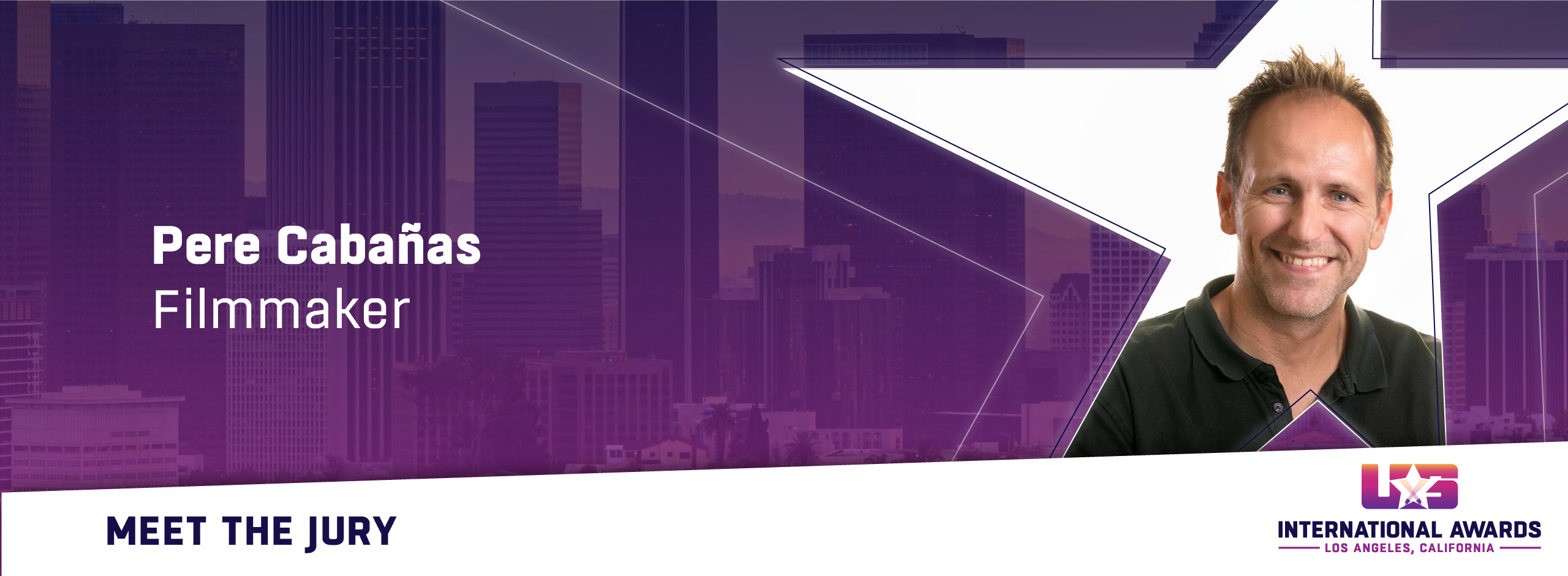
Blending documentary sensibility with branded storytelling and fiction, Pere Cabañas approaches filmmaking with what he calls a “freestyle” mindset — trusting intuition, emotion and authenticity over rigid formulas. As a filmmaker, editor and post-production professional, his work moves between commercial campaigns, corporate communication and deeply personal independent projects, always with a strong focus on human storytelling.
Now joining the jury for the 2026 US International Awards, Cabañas shares his perspective on creative risk-taking, emotional storytelling and why authenticity matters more than overproduction. From award-winning tourism campaigns to intimate documentary work created under emotionally difficult circumstances, his reflections offer an honest look at the balance between technical craft and genuine human connection in audiovisual communication.
We are thrilled to have you on the jury for the 2026 US International Awards. Please tell us more about your work background and your everyday work life. Could you also tell us what you enjoy the most in your job?
I come from a multidisciplinary audiovisual background combining documentary filmmaking, branded storytelling, commercial production and corporate communication. Over the years, I’ve worked across different formats and production environments, from independent and documentary projects to branded and corporate content.
My day-to-day work is usually a balance between storytelling, creative decision-making and technical post-production processes. Editing is often at the center of my work, but I’m also deeply involved in the narrative and emotional construction of each piece.
What I enjoy the most is probably the moment when a project finds its true rhythm and identity in the edit. I’m especially interested in projects that manage to combine visual precision with genuine emotion and a human perspective, regardless of the format or budget.
What projects have you done so far? Are there projects that stand out for you personally, and what was the most challenging project you worked on so far?
I’ve had the opportunity to work on a wide range of projects, including documentaries, branded content, commercial campaigns and corporate or institutional films. Some of the most meaningful experiences for me have been projects where storytelling and authenticity played a central role, especially documentary-oriented productions that required building trust, sensitivity and a strong narrative structure in post-production.
Probably the most challenging project I’ve worked on was also the most personal one: an independent short documentary filmed across different countries under extremely demanding conditions. The production involved constant time pressure, no opportunity for second takes during filming, and countless hours of editing and narrative reconstruction in post-production. On top of that, the project was created during an especially difficult personal period, while I was going through the grief of losing my mother. In many ways, that emotional context made the film more visceral, honest and emotionally exposed than any other project I had worked on before.
Looking back, I believe that authenticity became one of the project’s greatest strengths, and it was very meaningful to later see the film receive recognition at several international festivals.
What are you currently working on? And what else is planned for the upcoming time?
Recently, I’ve also had the opportunity to work in fiction, editing a very powerful short film focused on bullying and its emotional impact. It has been a particularly meaningful experience from both a creative and human perspective, especially because of the sensitivity and emotional balance that this kind of subject requires in the editing process.
At the moment, I’m also working on a documentary project connected to science and philanthropy, which explores the human dimension behind scientific research and social impact initiatives.
Looking ahead, I hope to continue combining documentary, branded storytelling and fiction projects, while staying curious, taking creative risks and continuing to explore the expressive possibilities of audiovisual language.
What’s a creative risk you took recently? How did it turn out?
In a way, I feel that taking creative risks is part of my natural approach to filmmaking. I tend to relativize overly academic rules and leave space for intuition, spontaneity and emotional instinct during the creative process. I often describe it as my own kind of “freestyle filmmaking.”
One creative risk I’ve taken recently was embracing a more restrained and minimalistic storytelling approach in a project where the initial tendency was to over-explain everything visually and narratively.
We decided to trust silence, pacing and atmosphere more than explicit messaging, allowing the audience to engage emotionally instead of simply receiving information. It required confidence from everyone involved, but the result felt much more honest, visceral and impactful.
For me, some of the strongest creative decisions come precisely from letting go of excessive control and trusting intuition.
What does an award represent to you?
An award is, above all, a form of recognition for the collective effort behind a project. Audiovisual work is always collaborative, and awards help give visibility to the many creative and technical professionals involved in making a piece possible.
At the same time, I believe awards are most valuable when they celebrate originality, authenticity and meaningful communication rather than just technical perfection or trends.
In your opinion, what makes a “good” corporate video? Alas, what are you looking for in a winning entry?
For me, a good corporate video is one that communicates clearly while still feeling human, honest and emotionally engaging. Today, audiences are extremely sensitive to authenticity. A corporate film should not feel like advertising disguised as emotion — it should communicate something truthful, human and meaningful.
The strongest pieces are usually the ones that combine clarity of message with authentic storytelling, strong visual language and emotional intelligence. Technical quality is important, of course, but what truly makes a project memorable is its ability to connect with people in a genuine way.
In a winning entry, I would look for originality, coherence, emotional impact and a clear creative vision behind the execution.
Are there any tips for potential entrants? Production-wise and presentation-wise?
I would encourage entrants to focus first on the strength of the idea and the authenticity of the storytelling rather than trying to impress purely through technical complexity. Simplicity and clarity are often much more powerful than overproduction.
From a production perspective, attention to rhythm, sound design and narrative structure can make an enormous difference, even in shorter formats.
I would also encourage creators not to be afraid of taking creative risks and developing a personal voice. The projects that usually stay with us are rarely the safest ones — they are the ones that feel honest, distinctive and genuinely connected to the filmmaker’s perspective.
Presentation-wise, I think it’s important that the intention behind the project is clearly communicated. Understanding why a creative decision was made is often just as important as the final visual result itself.