Meet the Jury Interview
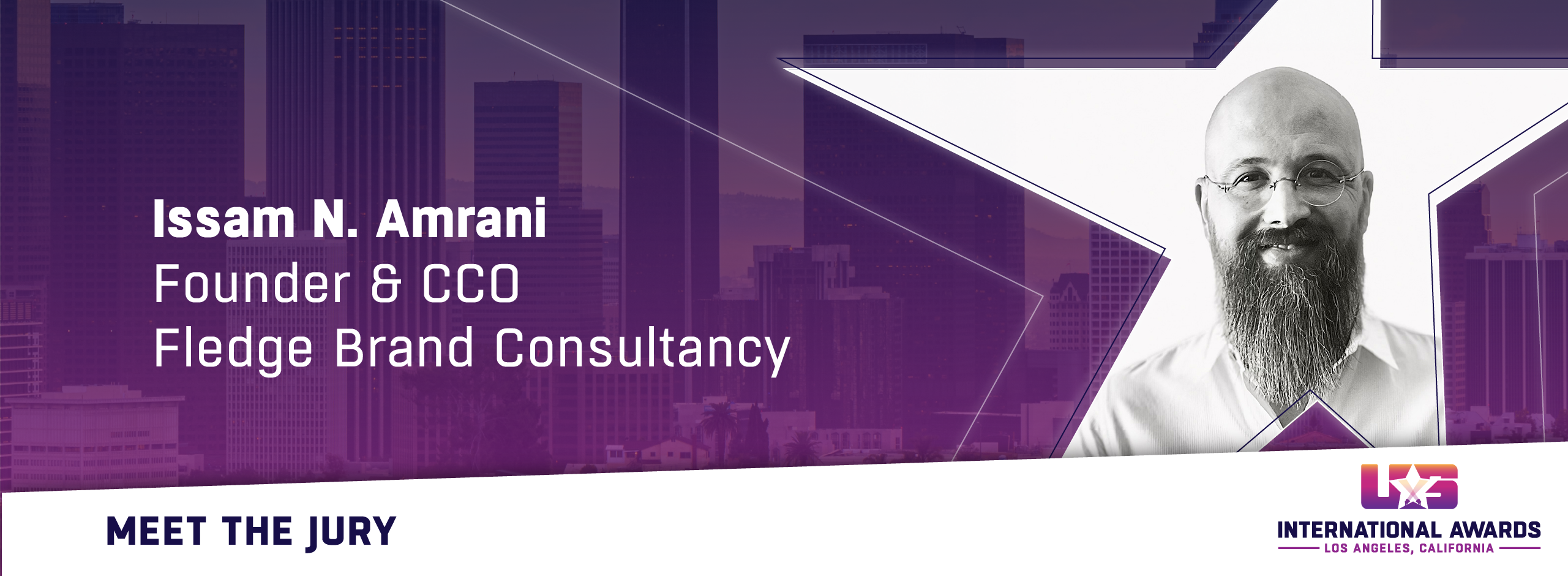
Issam N. Amrani
We’re pleased to welcome Issam N. Amrani, Founder and Chief Creative Officer of Fledge Brand Consultancy, to the jury of the 2026 US International Awards. With more than 25 years of experience across advertising, brand strategy, and design, Issam has built a career defined by intention. His work spans Africa, the Middle East, and Europe, guiding brands through launches, transformations, and long-term narrative building with a disciplined, story-first approach.
A seasoned judge and creative leader, Issam is known for carving clarity out of complexity—aligning strategy, design, and storytelling into coherent systems that endure beyond campaign cycles. In this interview, Issam shares more about his path, the standards that recognition should reflect, and why the strongest corporate films say less—but mean more.
We are thrilled to have you on the jury for the 2026 US International Awards. Please tell us more about your work background and your everyday work life. Could you also tell us what you enjoy the most in your job?
Over the past 25 years, my work has evolved at the intersection of brand strategy, storytelling, and design. I began in advertising, working across diverse markets, and over time moved into broader creative leadership, shaping brand narratives that live consistently across film, digital, spatial design, and culture.
My everyday work life is less about inspiration and more about structure. It involves listening carefully, defining the right problem, aligning teams, and protecting the integrity of the idea from concept to execution. I spend a lot of time refining and simplifying what feels complex and ensuring that every creative choice serves the narrative.
What I enjoy most is the moment when clarity emerges. When a story finds its right rhythm. When a team moves from scattered ideas to a unified vision. That transition from noise to coherence is where the real craft lives.
For me, creativity is not about spectacle. It’s about discipline, intention, and respect for both the craft and the audience.
What projects have you done so far? Are there projects that stand out for you personally and what was the most challenging project you worked on so far?
Over the years, I’ve worked across sectors from FMCG and automotive to technology, public institutions, and emerging startups. My projects have ranged from large-scale brand launches to long-term brand transformations, as well as purpose-driven campaigns and cultural initiatives across Africa, the Middle East, and Europe.
The projects that stand out for me personally are not necessarily the biggest ones, but the ones where clarity had to be carved out of complexity. Brand architecture projects, in particular, remain close to me because they require aligning strategy, design, and storytelling into one coherent system. When structure and narrative come together seamlessly, the work gains longevity.
The most challenging projects are always the ones involving transformation when a brand must evolve without losing its essence. That tension between heritage and reinvention is demanding. It requires listening deeply, resisting shortcuts, and guiding teams through uncertainty while protecting the integrity of the idea.
Looking back, I don’t measure projects by visibility alone, but by whether they stood the test of time and created meaningful impact beyond the campaign cycle.
What are you currently working on? And what else is planned for the upcoming time?
At the moment, I am focused on projects that require structuring ideas into clear and lasting narratives. Much of my work revolves around helping organizations and teams move from scattered concepts to coherent systems where strategy, design, and storytelling speak the same language.
At the same time, I remain actively involved in mentoring and guiding emerging creatives and founders. I find great value in helping others build discipline in their thinking and confidence in their voice. Teaching and coaching often sharpen my own perspective.
Looking ahead, I am exploring how storytelling evolves in an environment shaped by new technologies and faster cycles of content. The challenge is not to create more, but to create with intention. The future, in my view, belongs to those who can combine technological fluency with strong creative fundamentals.
The focus remains simple: clarity, structure, and depth in everything that is built.
What’s a creative risk you took recently? How did it turn out?
Recently, I found myself in a situation where the natural instinct was to amplify everything. Bigger visuals, faster pacing, more layers. The energy in the room was pushing toward intensity.
I felt the idea needed the opposite.
We stripped it back. Removed elements that were technically impressive but narratively unnecessary. Left space where others expected noise. That decision was not immediately comfortable. Simplicity demands confidence, and it puts the idea under greater scrutiny.
The final result carried more weight precisely because it was restrained. The audience engaged with the story rather than the surface. It reinforced something I have learned over time: subtraction can be the boldest creative move.
What does an award represent to you?
In an industry that moves quickly, recognition creates a pause. It creates a moment to step back and ask whether the work truly carried intention, discipline, and respect for the audience.
What matters is not the object itself, but the standard it reflects. When something is awarded, it quietly raises the bar. It reminds teams that craft is noticed, that restraint can compete with spectacle, and that clarity can endure beyond a launch cycle.
At its best, recognition becomes a reference point. Not a finish line, but a benchmark that challenges the next piece of work to go deeper, think harder, and build with greater care.
In your opinion, what makes a “good” corporate video? Alas, what are you looking for in a winning entry?
Too often, corporate videos try to explain everything. The strongest ones do the opposite. They choose a clear point of view and build around it with discipline.
Clarity is essential. Not simplicity for the sake of being simple, but clarity of intention. Every frame, every word, every cut should serve a defined narrative purpose. When a piece feels overloaded, it usually signals uncertainty about what it truly wants to say.
What stands out in a winning entry is coherence. Strategy, message, tone, and execution working in the same direction. Craft matters deeply. Cinematography, sound, pacing. But none of these can compensate for a weak core idea.
The most compelling work respects its audience. It does not shout. It does not overstate. It trusts the viewer enough to engage with the story rather than just consume information.
In the end, the difference is often restraint. Knowing what to leave out is as important as knowing what to show.
Are there any tips for potential entrants? Production-wise and presentation-wise?
Entries that resonate usually feel intentional from the first frame. There is a clear decision behind them. A point of view that does not try to please everyone at once.
When the foundation is strong, the execution follows naturally. Light, sound, rhythm and pacing become extensions of the idea rather than additions to it. The strongest work rarely feels crowded. It feels resolved.
The same applies to how the project is presented. Context should clarify the thinking, not compensate for it. When the rationale is disciplined and coherent, the film can stand on its own.
Ultimately, what makes a submission memorable is not volume or complexity. It is alignment. When story, craft and intention move in the same direction, the work carries weight.