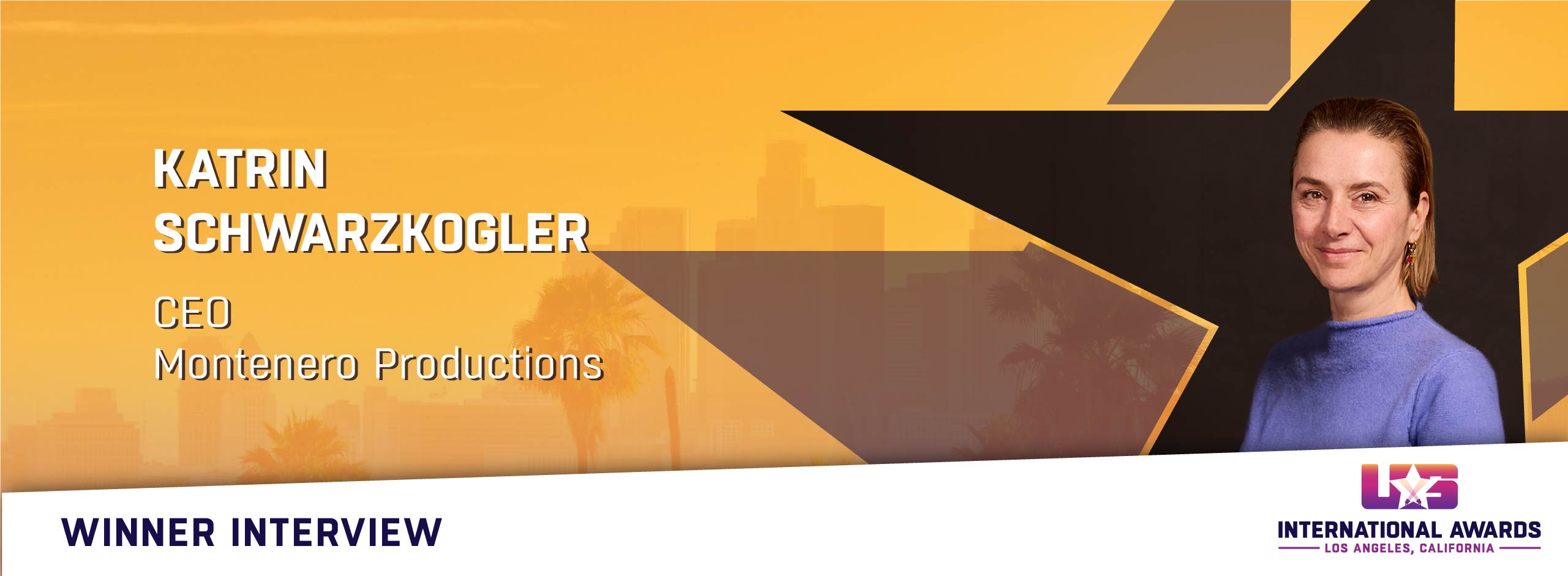
Today, we interviewed Katrin Schwarzkogler, CEO of Monte Nero Productions GmbH, a production company known for taking on unconventional projects, from branded content to experimental exhibitions. The studio primarily operates in the German-speaking market but serves clients across Europe. It works across film, digital media, and live events, frequently blending traditional production methods with modern technologies.
Monte Nero Productions' achievements at the US International Awards 2026 showcased their diverse excellence. They were named Production Company of the Year, won the Best Use of AI for "Future Radio – AI Special Exhibition Room," and earned two Silver Awards for "Loginns – From Graphite To Graphene" and "Riedel – Fatto a Mano – Black Tie." Additionally, "Kärntner Originale" and "Digital Austria Summit" were finalists in other categories, highlighting their impressive performance across multiple disciplines.
To learn more about the work behind this success, we spoke with the team about their creative approach and how they build a project from concept through delivery. The conversation covered their storytelling philosophy, the practical challenges of delivering award-winning work under tight deadlines, and how they approach technology and AI as creative tools that support, rather than replace, the creative process.
Q: Congratulations on being awarded the Production Company of the Year! What does this recognition mean for you and your team?
A: Thank you very much. Being awarded Production Company of the Year is a great honor and a meaningful recognition of what we have built as a team. Monte Nero is a relatively small studio, so every project is shaped very personally and closely by the people behind it — from concept and storytelling to design, animation, VFX, sound and final delivery. For us, this award celebrates not only individual projects, but also the way we work: with curiosity, precision, flexibility and a strong commitment to finding the right visual language for each story. It motivates the whole team and confirms that our approach can stand out internationally.
Q: Looking across the different projects you entered this year, is there a common creative vision or approach that connects them?
A: Yes, absolutely. Even though the projects differ in format, client and subject matter, they are connected by our belief that strong visual work always needs a clear emotional or narrative core. Whether it is a corporate film, an exhibition experience, a tourism campaign or a technology-driven project, we never want to create images just for spectacle.
Our goal is to translate complex ideas into visual experiences that feel clear, memorable and emotionally accessible. We combine cinematic storytelling, motion design, 3D, VFX and AI-supported workflows — but for us, technology is never the starting point. The client’s vision, the story and the emotional impact always come first.
Q: Which project do you feel best represents your work overall, and why?
A: That is difficult to answer because each project represents a different side of Monte Nero. But if we had to choose one, “Riedel – Fatto a Mano – Black Tie” represents our work particularly well.
The project combines many elements that are central to our studio: cinematic storytelling, atmosphere, precise visual craftsmanship and a deep respect for the subject. Glass is extremely challenging to portray convincingly. Transparency, reflections, light, material depth and movement all have to feel absolutely right.
What made the project especially meaningful was that the client was initially hesitant about creating an animated film. There was a concern that 3D animation could make the glass appear less refined or too artificial, and that it might not do justice to the elegance and quality of Riedel glass. We understood this concern very well — and it became the creative challenge of the project.
Our goal was to prove the opposite: that animation can not only represent glass accurately, but elevate it into a cinematic and emotional visual experience. By carefully shaping light, movement, atmosphere and detail, we were able to show the handmade character and premium quality of the Fatto a Mano Black Tie collection in a way that felt elegant, immersive and true to the brand.
For us, this film is a strong example of how we work: we do not simply visualize a product or process, but try to reveal its beauty, rhythm and emotional value.
Q: What were the biggest challenges in managing or producing multiple projects for this competition cycle?
A: The biggest challenge is maintaining focus and quality across very different projects at the same time. Each client has different needs, timelines and expectations. Some projects are highly technical, others are more emotional or brand-driven. We have to shift perspective constantly while keeping our creative standards high.
As a small studio, we work very closely across disciplines. That can be intense, but it is also one of our strengths. Decisions are fast, communication is direct and everyone involved has a strong influence on the final result. The challenge is to keep the process structured without losing creative openness.
Q: How do you maintain consistency in quality and storytelling across different clients, formats, or industries?
A: We start every project by understanding what really matters: What is the central idea? What should the audience feel or remember? And what visual language fits this particular story?
From there, we define a clear creative direction early on. This helps us stay consistent, even when the format changes — from corporate film to social media, exhibition installation or highly visual brand film. We also rely on a strong internal review process. Every frame, transition and design decision needs to support the story.
At the same time, we try not to repeat ourselves. Consistency does not mean using the same style again and again. It means applying the same level of care, clarity and ambition to every project.
Q: In your view, what has been the key factor behind your success in this edition of the US International Awards? What do you believe made your work stand out this year?
A: I think the key factor was the combination of strong storytelling, high production value and the willingness to explore new creative tools in a meaningful way. We are very interested in new technologies, including AI, but we do not see them as shortcuts. We see them as additional creative instruments.
What may have made our work stand out is that each project has its own clear identity and atmosphere. The films are visually strong, but also carefully shaped around the subject. This balance between craft, technology and emotion is something we care about deeply.
Q: Finally, how do awards like this impact your work moving forward?
A: Awards like this give us confidence, but they also raise the bar. They remind us that our work can travel beyond its original context and be understood internationally.
For our team, this recognition is a motivation to keep developing our visual language, take creative risks and continue combining film, design, animation, VFX and new technologies in thoughtful ways. It also helps us show clients that ambitious, visually distinctive work has real value — not only aesthetically, but also strategically.