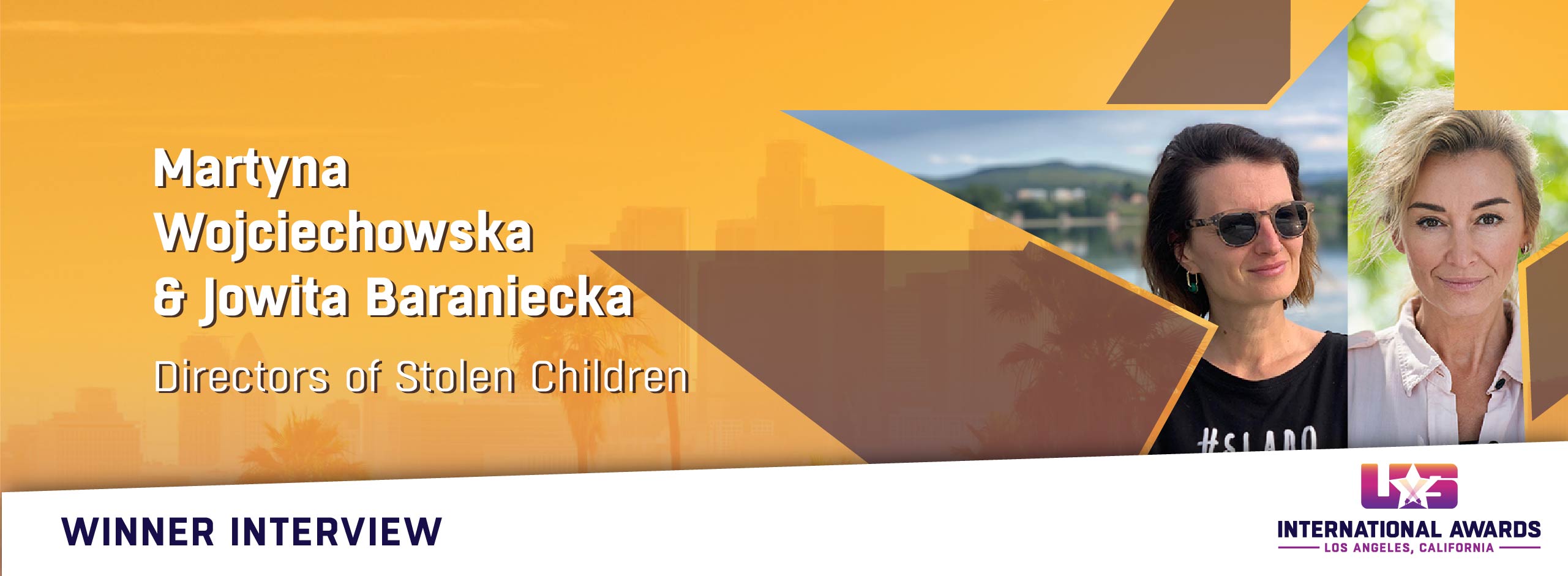
We are proud to highlight the work of Martyna Wojciechowska and Jowita Baraniecka, directors of the documentary Stolen Children, which received the Grand Award in Documentaries & Reports, Best Use of Emotion, and Gold Award in Social Issues at the 2026 US International Awards.
Martyna Wojciechowska is one of Poland’s best-known journalists, television presenters, and documentary filmmakers. She is the creator and host of the acclaimed Woman at the End of the World, Poland’s most recognizable travel-documentary series, which has taken her to 68 countries across six continents. Her work focuses on human rights and the stories of women and communities whose voices are rarely heard, and has earned numerous international awards.
Jowita Baraniecka is an award-winning television producer and director with more than 20 years of experience in documentary and television production. A graduate of the University of Warsaw and the Film School in Łódź, she has worked on productions for TVN and created and produced projects filmed around the world, including Lena in the Caucasus. Her international work spans countries including the United States, India, South Korea, Brazil, Japan, and Cameroon.
Both filmmakers share a commitment to telling deeply human stories from places and communities that are often overlooked—and to bringing difficult, complex subjects to audiences with sensitivity and journalistic integrity.
It was through Woman at the End of the World that the two first met Tamuna Museridze. Her search for the truth about her own origins ultimately uncovered a vast network that had stolen and sold babies in Georgia for decades, affecting up to 100,000 families. What began as a single episode evolved into a feature documentary that has since received international recognition.
The jury praised Stolen Children as “an excellent blend of journalistic investigation and documentary storytelling” and “a compelling piece of storytelling and an important act of social accountability,” adding: “The film tells a fantastic and deeply moving story.”
In this interview, the two directors discuss how the project came to life, the challenges of telling such a personal and sensitive story, and what they hope audiences will take away from the film.
Q: Congratulations on your Grand Award! What does it mean to you, your team, and everyone involved in this project to receive this recognition?
We are incredibly proud that a European documentary has received such prestigious recognition in the United States. We also hope that our film will help spread awareness of the tragedy of stolen children around the world and encourage more mothers and children to take DNA tests. For many families, discovering the truth about their origins can change their lives forever.
Q: How did this project come to life, and how did it evolve from concept to final execution?
For the past 18 years, we have been producing the television series Woman at the End of the World, which has told the stories of more than 130 extraordinary women from around the globe. One of them was Tamuna Museridze. We originally filmed just one episode with her, but from the very first moment we met her, we knew her story was far from over. We felt it deserved a much deeper exploration, which eventually became this documentary.
Q: What was the most challenging moment during the production process?
Tamuna's journey to discover the truth about her biological family was incredibly complex. Georgian society is deeply family-oriented, with large extended families, so there were many intertwined relationships and storylines to follow. Our greatest challenge was to simplify this complexity without losing its emotional depth, allowing the audience to focus on Tamuna's feelings, hopes, and struggles.
Q: Were there any moments during production when the story took an unexpected direction?
Absolutely. The biggest surprise came when Tamuna finally found her biological mother. Shortly afterward, she was supposed to meet her biological father, and our crew was already traveling to Georgia to film this moment. However, her relatives decided to surprise her and arranged the meeting one day earlier than planned. As a result, what you see in the film is not professionally filmed footage but a spontaneous phone recording of that very first encounter. In the end, this made the scene even more authentic and emotionally powerful.
Q: In your view, what made this project stand out and earn the Grand Award among such strong international competition?
Although our story takes place in Georgia, the tragedy of stolen and trafficked children is sadly universal. Similar cases have been documented in Spain, Ireland, South Korea, and many other countries. We believe the film resonates because it presents every perspective—the adopted child, the adoptive parents, and the biological family. Everyone in this story was deceived, everyone suffered, and everyone is searching for truth. That makes it a deeply human story that audiences around the world can relate to.
Q: Finally, what impact do recognitions like this have on your future work and strategic direction?
We hope audiences leave the film with empathy and a deeper understanding of how profoundly a hidden truth can shape a person's life. We also want people to realize that the search for identity is a fundamental human need, and that the truth—however painful—is sometimes better than living with uncertainty. Finally, we hope the film encourages anyone who suspects they may have been illegally adopted or separated from their family to seek the truth, because it is never too late.