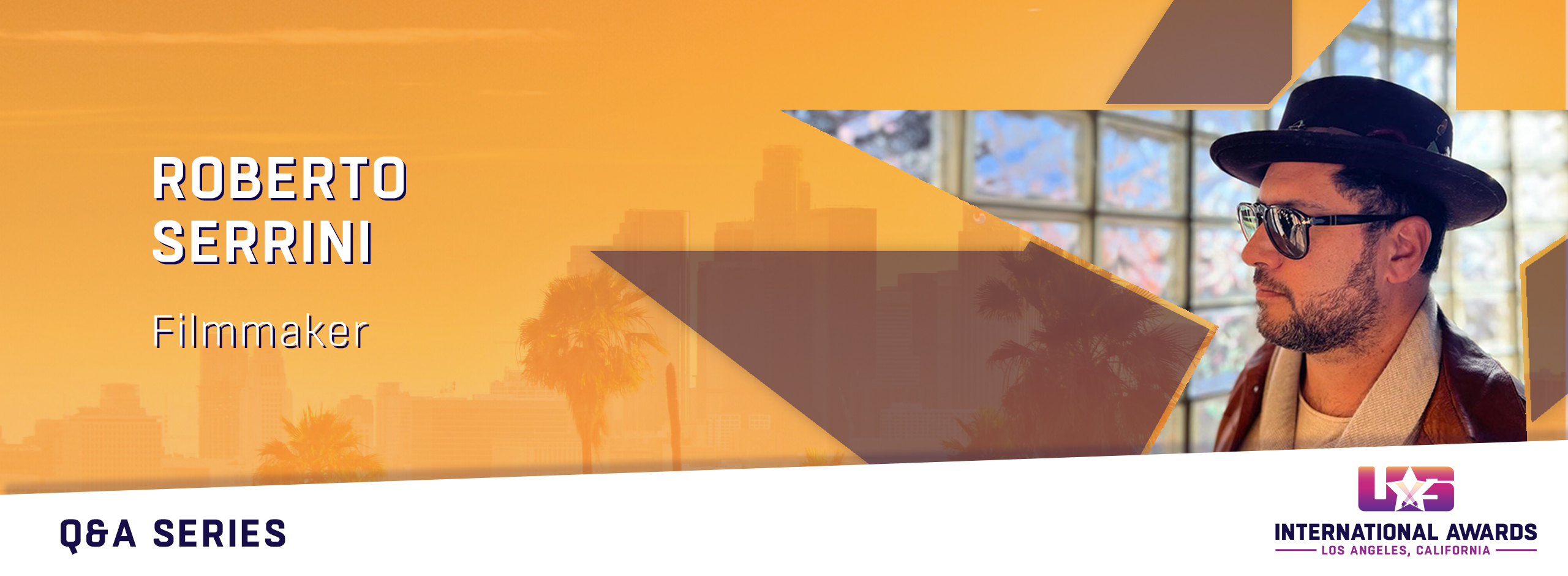
Our deep dive into the talented members of our jury continues, and this time, we are thrilled to spotlight a filmmaker whose creativity and expertise have left an indelible mark on both the brand film and documentary worlds.
In this sixth installment, we proudly present Roberto Serrini, an award-winning filmmaker and creative who has brought to life campaigns for iconic brands like Nike, Apple, and Honda. A frequent judge at world-class award shows, Roberto is honored to bring his expertise to this year's panel.
Which film director's style do you admire the most?
I am a big fan of Soderbergh. He lets creativity dictate execution, which I think is a beautiful way to make powerful content. He is a director who can go from big budget to pocket change, who can use any format out there, work with the biggest and smallest, and isn't afraid to attempt any style of genre. To me, that is someone really in love with the medium, who embraces the good and bad and makes love to it all the same. He's a fluid creative and someone I always think I'd have a lot in common with.
What's your guilty pleasure?
I know you're expecting frozen Reeses or something, but AI is my guilty pleasure. I love pushing the limits to see what it can do and blending it into my work creatively in ways that aren't obvious. When anything non-critical requires an answer, I always like to run it through some sort of AI fence to see what comes out the other side. Lots of times it is something you'd never consider, and that's when non-critical becomes interesting.
What work are you most proud of?
Recently, I would say my work with BMW. For their 100th anniversary, they wanted to do something special, capturing stories of riders from around the country. There wasn't any constraint creatively, so I was able to hand-craft these personal stories right from the core with minimal branding. Advertising can be so cringy, but there is a way to do it that is honest and powerful and requires no effort other than to be present to make it mean something. This project was like that, and the films are really beautiful moments in people's lives that BMW happens to be a part of as well, putting the story first and the brand second. It's won some beautiful awards, but the real win is the connection the film has made with so many people organically.
What's the most unique location you've filmed in?
It's funny, I've shot in some of the most exquisite and opulent places on earth, but I would say unique would be the small village of Anuk Lang in Cambodia. A good 4 hours outside of the nearest village we were completely off-grid with a group of individuals who had no concept of the internet, media, or the modern world. I remember the woman we were shooting a documentary about had a small, very old tube TV in her humble thatched hut. I asked the translator to ask what her favorite show was because I couldn't imagine what she watched out there. They went back and forth for a bit, and finally, the translator said, "She doesn't understand the question. That is a lamp." It was at that moment I understood what perspective really means and how powerful it is. To understand someone else's reality is no small feat, but if you are able to find that perspective, then you are able to shift the world around you. I would say discovering that was unique.
If you could work with any film production company or agency, which would it be?
I've been in it long enough to work with some of the greatest like BBDO, RG/A, HAVAS, McGarryBowen, and 72&Sunny, but there are so many amazing creative studios out there I am constantly on the hunt for new genius to play with. I love what The Wild Factory is doing and who they are doing it with. I also have a soft spot for Highdive, Pink Buffalo, and Giant Spoon.